You use a bracing system in a steel structure to give it strength and keep it stable. Bracing in steel structures helps you resist forces from wind or earthquakes that might push the building sideways. When you add bracing, you make sure the structure does not sway or collapse. This safety feature protects people and property. Qcxsteelstructure designs strong and reliable solutions so you can trust your building will stand firm.
Bracing System Functions in Steel Structure
Structural Stability
You rely on bracing in steel structures to keep your building steady when wind or earthquakes push against it. Bracing systems resist these lateral forces and help your steel structure stand firm. When you use different types of bracing, you improve the building’s ability to handle stress from all directions.
In dense urban areas, bracing in steel structures lets you build taller and safer buildings that can withstand strong winds and seismic events. You get better performance and peace of mind.
Here is a table showing how bracing systems help your steel structure stay stable under lateral loads:
Benefit | Description |
Seismic Resistance | Buildings can better withstand seismic forces and recover after an event. |
Structural Stability | Improves lateral stability without compromising architectural intent. |
Design Versatility | Supports various layouts, giving architects freedom while preserving space. |
Bracing systems also increase the stiffness of your steel structure and reduce the risk of buckling in columns and beams. You can choose from many types of bracing to match your building’s needs. Qcxsteelstructure focuses on safety and durability, so you get a solution that lasts.
Load Distribution
Bracing in steel structures does more than just keep your building upright. You use bracing to spread loads evenly across the frame. This means your steel structure can handle heavy weights and sudden forces without damage.
Bracing systems provide stability and strength to steel structures.
They ensure even distribution of lateral and vertical loads between main beams.
Bracing helps resist lateral forces, enhancing structural integrity during events like earthquakes.
Horizontal bracings distribute loads from perimeter columns to vertical bracing, countering wind forces.
Vertical bracings transfer horizontal forces to the ground, ensuring overall stability.
When you use different types of bracing, you make sure that every part of your steel structure shares the load. Diagonal bracing provides lateral stability and helps transfer loads. Pre-manufactured pipe bracing with clamps gives you adjustable support. Custom shores using hollow structural sections work well for high loads or tall buildings. Qcxsteelstructure designs bracing systems that keep your building safe during construction and for years to come.
Buckling Control
You need bracing in steel structures to prevent buckling in columns and beams. Buckling happens when a steel member bends or twists under pressure. Bracing systems give lateral support and stop these parts from moving too much.
Here is a table showing how bracing controls buckling in steel columns:
Study Type | Key Findings |
Experimental Investigation | The LYPSBRB fabricated with LYP160 steel achieves a peak yield load of 173.84 kN, maintaining stable energy dissipation even under large deformations exceeding 2% of the yield segment dimensions. |
Numerical Study | Parametric analyses revealed that cyclic energy dissipation capacity shows less than 3% sensitivity to friction coefficient variations and that a 60% increase in core member length can double energy dissipation capacity before triggering global instability. |
Bracing provides lateral restraints that prevent deflections in steel members. This increases the critical buckling load and lets your steel structure carry more weight. X-shaped bracing is especially good at stopping sway buckling and the first buckling mode. You can use many types of bracing to control buckling and keep your building strong.
During construction, bracing systems control buckling in main beams and prevent instability under compression loads. They distribute loads to the beams and then to the foundation, reducing stress and preventing damage. Bracing helps maintain the integrity of the framework, so you avoid major failures or deformation.
Bracing systems also ensure long-term safety and durability. They transmit lateral forces to the foundation and adjust the stiffness of your steel structure, making sure stress spreads evenly. Qcxsteelstructure’s steel structure solutions use advanced types of steel bracing to keep your building safe and reliable for years.
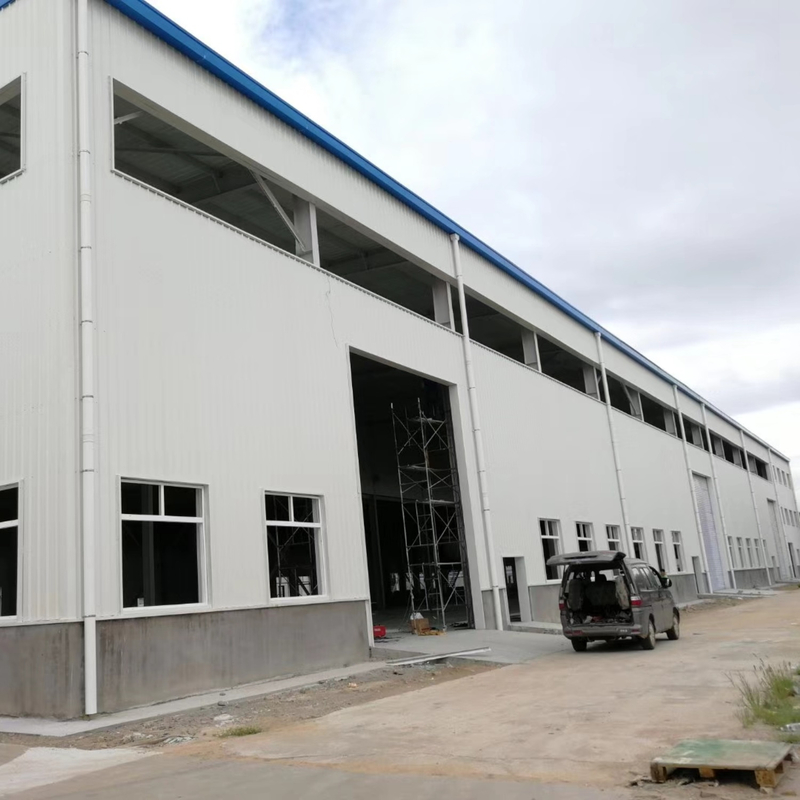
Types of Bracing in Steel Structures
Cross-Bracing
You use cross-bracing when you want to resist strong horizontal forces in a steel structure. Cross-bracing forms an X-shape between beams and columns. This type of bracing helps your building stay steady during wind or earthquakes. You often see cross-bracing in warehouses, workshops, and tall buildings. It gives you flexibility in design and works well for many building types.
K-Bracing
K-bracing creates a V-pattern that connects from the columns to the center of the beams. You choose K-bracing when you need more design options, especially if you want to add doors or windows in the wall frames. Here are some points to consider:
K-bracing gives you greater design flexibility and lets you place openings more easily.
K-bracing has lower lateral strength than cross-bracing and may deflect more under heavy loads. It does not perform as well in seismic zones.
You often use K-bracing in medium-height steel structures where you want a balance between stability and design freedom.
V-Bracing
V-bracing forms an upside-down V between columns and beams. You use V-bracing to improve stability in multi-story steel structures. This type of bracing reduces how much your building moves during earthquakes or strong winds. The table below shows how V-bracing performs in different studies:
Study Title | Findings |
Experimental Study on Steel Frame Building with Steel Bracing by Seismic Analysis | V-bracing improves stability in multi-story buildings. |
Seismic Performance Analysis of RC Frame Building Using Different Types of Steel Bracing | V-bracing reduces displacement and interstorey drift. |
Seismic Analysis of Steel Building with Bracing | V-bracing is crucial for resisting lateral loads during earthquakes. |
You can use V-bracing in workshops, warehouses, and commercial buildings where you need both strength and adaptability.
Horizontal and Vertical Bracing
You use horizontal bracing in floors and roofs to form flat or angled supports. Vertical bracing sits between columns or inside walls. Both types help your steel structure resist lateral forces. The table below explains their roles:
Bracing Type | Application | Effectiveness in Lateral Load Resistance |
Horizontal Bracing | Forms diaphragms in floor and roof systems. | Transfers lateral loads to vertical elements. |
Vertical Bracing | Placed in vertical planes, between columns or within walls. | Moves lateral forces from floors and roofs to the foundation. |
You find these bracing types in almost every steel structure, from small workshops to large warehouses. They make your building stronger and more adaptable.
Braced Frame Structure
A braced frame structure uses bracing to connect beams and columns, forming a strong skeleton. You choose a braced frame when you want to increase stability and reduce material costs. Braced frames work well in multi-story buildings, especially in areas with earthquakes or strong winds. You see them in industrial and commercial steel structures because they:
Enhance stability and rigidity.
Distribute lateral loads and minimize deformation.
Allow for lighter beams and columns.
You can use a braced frame structure in many building types, making it a popular choice for workshops, warehouses, and shopping malls.
Tip: When you select the right bracing type, you make your steel structure more adaptable for future changes or expansions.
Bracing Design Principles
Load Paths
You need to create clear load paths when you design bracing for a steel structure. A good load path lets forces travel safely from one part of the building to another, all the way to the foundation. You want your load paths to be:
Continuous, with no gaps or missing supports.
Predictable, so you do not rely on parts that are not meant to carry loads.
Strong and stiff enough to handle the forces.
Compatible, with connections and supports lined up with the direction of the forces.
Redundant, so if one part fails, others can take over.
You should keep load lines straight and avoid sudden changes in stiffness. This helps prevent progressive collapse and keeps your building safe during overloads.
Placement and Configuration
The placement and configuration of bracing affect how your steel structure performs, especially during earthquakes or strong winds. You must choose the right type and location for each bracing system. The table below shows how different bracing configurations influence building movement:
Bracing Configuration | Inter-Story Drift (ISD) | Floor Acceleration (FA) |
I-VBF | Even ISD across floors | Rises with height |
VBF | Highest ISD on most floors | Rises with height |
XBF | Even ISD across floors | Rises with height |
SZBF | Lowest ISD at 1st floor | Rises with height |
M-XBF | Similar to SZBF | Rises with height |
You can see that the right bracing placement reduces building sway and improves safety. Qcxsteelstructure offers custom solutions to match your building’s unique needs.
Integration with Steel Structure Elements
You must connect bracing systems well with beams and columns. Good integration means your building stays strong during wind or seismic events. Modern connections, like the Yield-Link brace, use predesigned bolts instead of welding. This makes installation easier and keeps damage away from main parts of the structure.
You should also work closely with design professionals to make sure your bracing fits with other building elements. Custom bracing solutions let you create taller walls, wider spaces, and unique designs while keeping your structure safe and efficient. Qcxsteelstructure focuses on adaptability, so you get a bracing system that works for your project.

Advantages and Disadvantages of Bracing
Benefits of Bracing Systems
You gain many advantages when you use bracing in steel structures. Bracing helps your building stay strong and safe, even during extreme weather or earthquakes. You can rely on bracing to keep your steel structure upright and stable. Here are some key benefits:
Bracing improves structural integrity and safety for metal buildings.
You protect your building from wind and seismic activity.
Bracing distributes forces evenly, which prevents bending, swaying, or collapse.
You lower long-term repair costs because bracing helps your building withstand external forces.
Bracing can reduce insurance premiums by making your building safer.
Efficient bracing designs help you save on construction costs.
You also benefit from the fire resistance and sustainability of steel structures. Steel does not burn, so bracing systems help contain fires and protect people and property. Steel supports recycling and resource conservation, which makes your building more sustainable. Qcxsteelstructure uses durable and energy-efficient steel, so you get a long-lasting and green solution.
Tip: Bracing systems make your building safer and more cost-effective, while supporting environmental goals.
Comparative studies show that bracing systems greatly reduce lateral displacement. For example, crossed bracing can lower lateral movement by 41%. X-bracing reduces displacement by up to 53% in some directions, and diagonal bracing also performs well.
Limitations and Challenges
You should know about some challenges when you use bracing in steel structures. The table below highlights common limitations:
Limitation/Challenge | Description |
Span Length Restriction | Bracing can limit the span length to about 40 feet when reinforced. |
Need for Skilled Workmanship | You need skilled workers to install bracing systems correctly. |
Bracing systems require careful planning and expert installation. You must work with professionals to make sure your bracing fits your building’s needs. When you choose the right bracing type and placement, you overcome most challenges and get the best results for your steel structure.
You play a key role in making steel structures safe and strong by choosing the right bracing system. Bracing improves seismic performance, controls building movement, and protects against wind or earthquakes. Recent research highlights advanced options like buckling-restrained braces and diamond cable bracing for better stability.
Recommendation | Benefit |
Engage engineers early | Efficient bracing and anchoring decisions |
Optimize placement | Effective bracing distribution |
You can trust Qcxsteelstructure to help you select and design the best bracing for your project.
FAQ
What is the main purpose of bracing in steel structures?
You use bracing to keep your steel structure stable. Bracing helps your building resist wind and earthquake forces. It prevents swaying and collapse.
Where do you usually place bracing in a steel structure?
You often place bracing between columns, inside walls, or across floors and roofs. This placement helps your building handle lateral loads and stay strong.
Can you add bracing to an existing steel structure?
Yes, you can add bracing to an existing structure. You should work with engineers to choose the right type and location for the best results.
How do you choose the right bracing type for your project?
You look at your building’s size, use, and location. You also consider wind and earthquake risks. Qcxsteelstructure can help you select the best bracing system for your needs.


